M2 Equation
The article presents EXHLAB’s review of the M2 equation, a formulation of relativistic quantum mechanics tested first on hydrogen-like atoms.
Keywords: Relativistic Quantum Mechanics, M2 Equation, Bounded Momentum, Hydrogen-like Ions, Dirac Benchmark, Whittaker Equation, Coordinate Realization
−13.60587426
electron volts
Hydrogen 1s energy shift relative to the rest threshold.
The M2 ground-state energy passes the hydrogen benchmark in exact agreement with the Dirac result.
From the energy–momentum relation to M2
M2 starts from the free-particle relation E² − c²P² = m²c⁴, with E including rest energy. Relativistic momentum is P = γmv. The bounded variable is p = mv, defined for v < c. Substituting and rearranging gives the free M2 Hamiltonian, H0(p) = mc² √(1 − p²/(m²c²)), on the positive energy branch. The derivation is algebraically exact. P and p are different variables for the same kinematics: P = p / √(1 − p²/(m²c²)), and p = P / √(1 + P²/(m²c²)). As v approaches c, P grows without bound and p approaches mc.

Figure 1. Relativistic momentum P and the bounded variable p as functions of speed. P is shown in coral and p in lime.
Geometry of the two momenta
In ordinary relativistic momentum, the mass shell is a hyperboloid over an unbounded domain. In the M2 variable, finite-energy states of a massive particle lie inside the sphere |p| = mc. The sphere is the boundary, corresponding to infinite free energy. This picture explains the change of momentum variable. A coordinate metric, operator, inner product, and boundary condition still have to be chosen separately.

Figure 2. Massive special-relativistic energy surface at Pz = 0.

Figure 3. Spherical boundary |p| = mc. The finite-energy domain lies inside the sphere.
Interaction and the hydrogen-like potential
For a static potential, the review adopts E = H0(p) + V, with E − V > 0. For a pointlike fixed nucleus, V = −Z/r. In Hartree atomic units the coordinate realization uses R = r + a, where a(E) = Z/E. The Laplacian and the measure are written in R, while the potential keeps its dependence on r. At fixed energy the line element is ds² = dR² + R²dΩ² on R ≥ a. This operator assignment is a postulate of the M2 coordinate realization.
Analytic solution
For 0 < E < c² the radial equation becomes Whittaker’s equation. Termination of the confluent-hypergeometric series, λl(E) − κ(E) = −nr, selects the polynomial branch and gives decay at infinity. The ground state nr = l = 0 then has the closed form E00(Z) = c² √(1 − Z²/c²), for 0 < Z < c. The energy relative to rest is ε00 = E00 − c².
Hydrogen-like benchmark
Hydrogen is the first test. With c = 137.03599971 and 1 Ha = 27.211386245981 eV, the review reports:
Z = 1, nr = 0, l = 0: −0.5000066566 Ha, −13.60587426 eV
Z = 1, nr = 1, l = 0: −0.1249970880 Ha, −3.40134404 eV
Z = 20, nr = 0, l = 0: −201.0765232009 Ha, −5471.57093782 eV
The exact agreement with Dirac is for the ground 1s states. The first radial excitation is computed from the same series condition. Binding energies for nuclear charges Z = 1 through 100 follow the Dirac 1s curve in this model.

Figure 4. Ground-state binding energies for 1 ≤ Z ≤ 100. Point nucleus, with no recoil or radiative corrections.
Wave functions
The normalized l = 0 functions are finite at r = 0. The ground state has no node. The first radial excitation has one node. Each state uses its own shift a = Z/E. The radial probability density integrates to 1 over r.
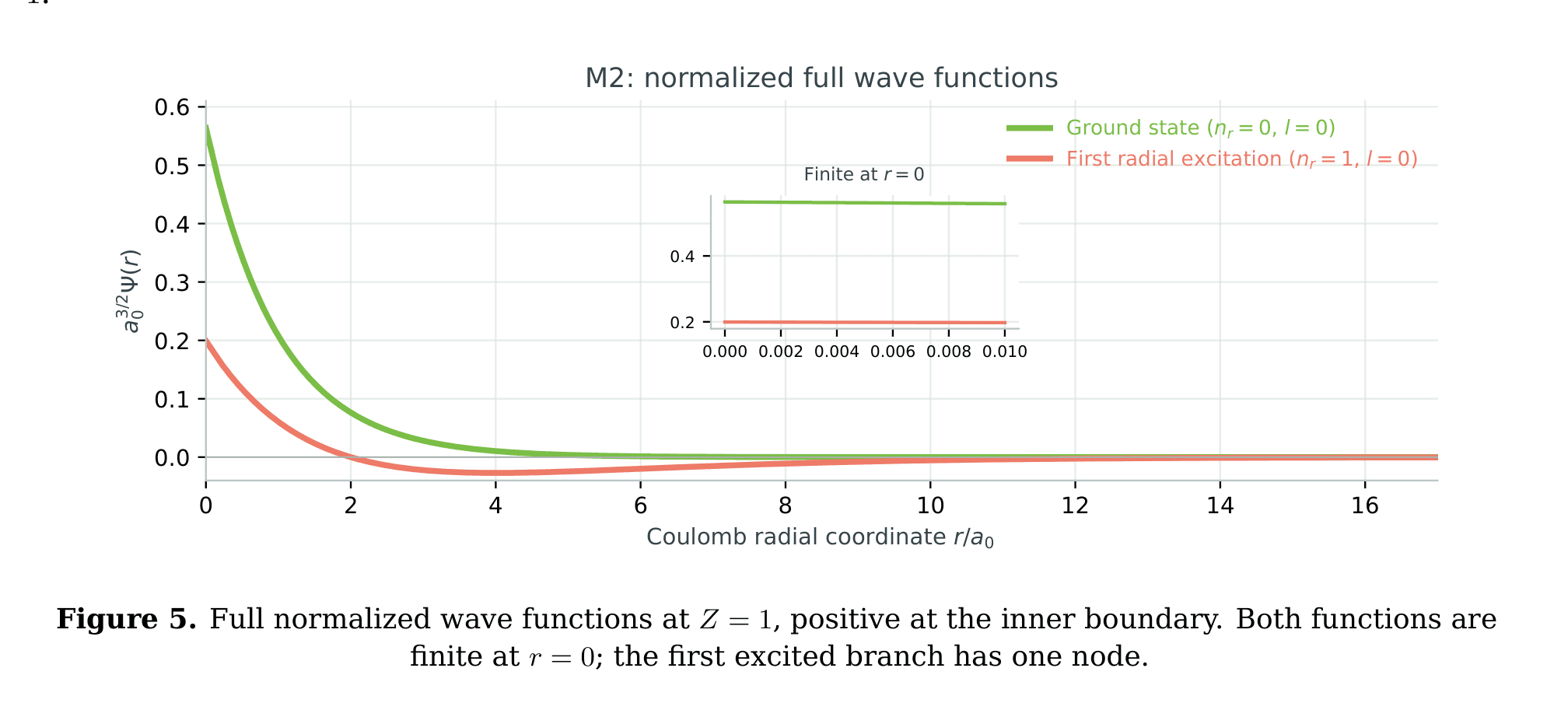
Figure 5. Normalized full wave functions at Z = 1. Both are finite at the inner boundary.

Figure 6. Radial probability densities for the ground state and the first radial excitation.
Scope of the benchmark
The benchmark is the ground-state energy of a hydrogen-like ion with a pointlike, fixed nucleus. Fine structure, the full spectrum, wave-function equality, nuclear recoil, finite nuclear size, and radiative corrections lie outside this review. Because a depends on energy, states of different energy are not assumed to be orthogonal in one fixed inner product. Finiteness at r = 0 still leaves the inner boundary condition and a self-adjoint formulation for later work.
Invitation
EXHLAB offers M2 as a tool for other quantum problems. The stationary Coulomb realization is specified here. Time-dependent and two-particle formulations need their own statement of the interaction, the variables, and the operator ordering. Researchers are invited to test the equation, compare it with known solutions, and report both applications and limitations. The supplied code reproduces the energies, normalizations, figures, and differential residuals.
A. E. Dangyan · Arayik@exhlab.com
M2: A New Equation of Relativistic Quantum Mechanics
EXHLAB’s review of the M2 equation and its hydrogen-like ground-state benchmark.